I believe AI should help us experience life better. It should give us more time with people, help us discover things we want to do, and take care of the screen work that gets in the way. For that to happen, the AI has to be private and yours. I am building Local and Experience because I want technology and life outside the screen to work for each other.
Who am I?
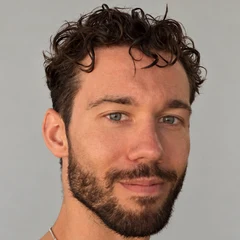
Hi, my name is Ilia Vasko. I'm a founder, an entrepreneur, an engineer, and an AI architect. In 2022, at 22 years old, I co-founded Tangle, an Antler-backed EdTech startup focused on bringing people together. We raised a total of €400,000 and organized thousands of events. In 2025, I sold my shares, exited, and started SimpleAI, where I taught AI workshops, upskilled professionals, and increased the adoption of AI in companies around the Netherlands. In 2026, I joined Jarvis as Head of Partnerships and Operations, building the agent harness Local runs on. Now I am building Local, and this page is why.
My thesis
Below, I have put together the data and my vision for the future. I would love to hear what you think about it, and whether I missed anything important that I should add.
Two things are here to stay: AI and people's need for experiences. We will keep developing intelligence that can do more for us. We will also keep wanting to meet people, go places, learn something with our hands, and have evenings we could never have planned.
The demand for experiences is measurable in money. Travel experiences alone were a $271 billion market in 2025, growing faster than travel overall. Airbnb relaunched Experiences in 650 cities in 2025 with up to $250 million behind its new businesses, and a year later had nearly 80 percent more experiences on offer. Live Nation sold to a record 159 million fans in 2025. Fever, which sells live experiences, raised $250 million in September 2026 and explained the round in one sentence: "In a world rapidly being reshaped by AI, demand for in-person, shared experiences is accelerating." I believe that sentence, and I want to build on the side of it that most technology companies ignore. Arival and Phocuswright, 2026 · Skift, 2025 · Airbnb, 2026 · Live Nation, 2026 · Music Business Worldwide, 2026
We are conscious beings with lives of our own. We can use a tool, turn it off, and continue living. I want to keep that freedom as AI becomes more capable and more involved in our days.
What is going wrong
Technology promised to give us time. We now spend much of that time managing the technology itself. There are inboxes to clear, files to organize, calendars to update, and apps that each need something from us.
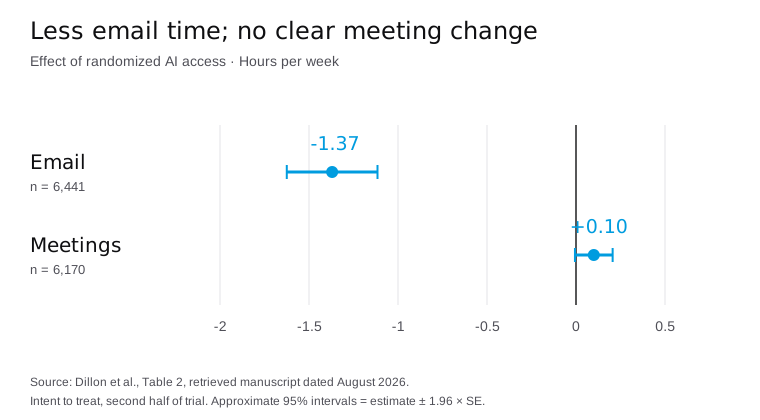
AI can help with those tasks, but using it often creates another sequence of tasks. You stop what you are doing, open a screen, explain the context, write a prompt, check the answer, and move it somewhere useful. Tomorrow you may have to explain yourself again.
I have spent a lot of time teaching people to use AI. I believe in what it can do. I also think we should question how much effort a person has to put into making it useful. When getting help requires us to keep feeding and managing software, we start arranging our days around its needs.
I want to be able to finish a conversation at a cafe and stay with the person across from me. The AI could prepare the follow-up while we continue talking. I would review it and decide what happens next.
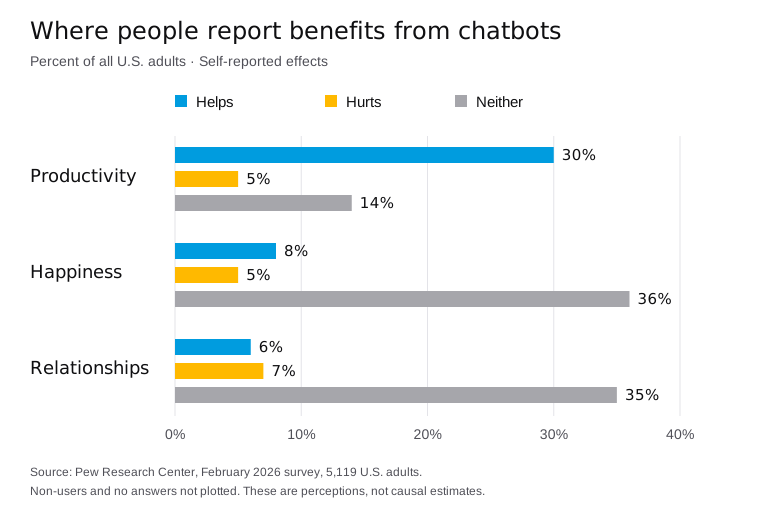
Pew's survey shows a gap between how people describe the effect of chatbots on productivity and on relationships. It gives us a reason to ask what useful AI should help a person do beyond finishing tasks. Pew, 2026
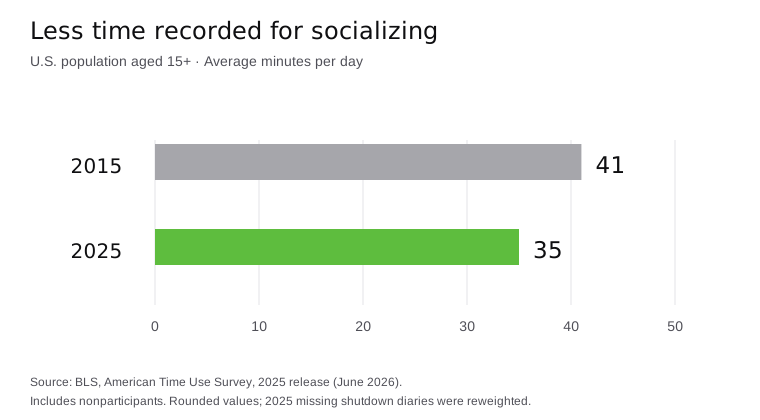
The time goes somewhere. The U.S. time-use survey shows average daily time spent socializing and communicating fell from 41 minutes in 2015 to 35 in 2025. Making room for people deserves attention. BLS, 2026
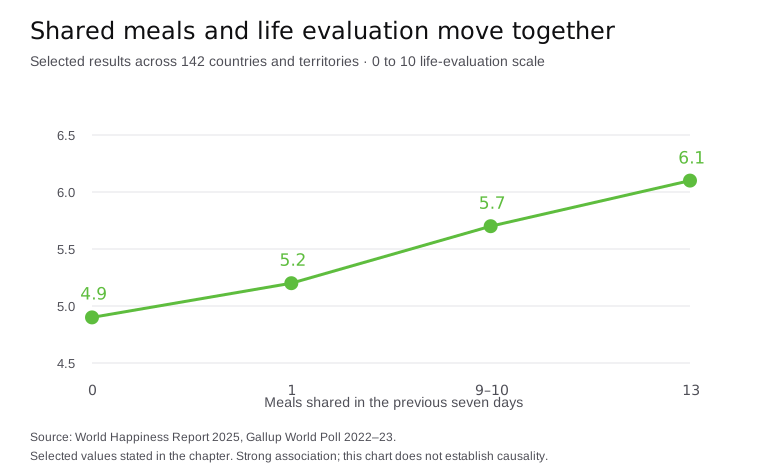
The positive evidence matters as much as the decline. The World Happiness Report compared meal sharing across 142 countries and territories. People who shared more meals reported greater life satisfaction and more positive emotion, an association as strong as income and unemployment in the report's analysis. It gives us something concrete to value: ordinary time with other people. World Happiness Report, 2025
There is no single colorful way to live. Some people want novelty, travel, and a room full of strangers. Others want depth, craft, routine, or a long dinner with three people they know well. Every person finds their own way. The truth underneath is the same: life is about doing things, living experiences, and spending time with people. Do you see it this way too?
To live that way on purpose, I started measuring my life from different angles, and so did a lot of other people. Wearables have become ordinary: IDC counted 145.7 million wearable-device shipments in the first quarter of 2026, and Oura expected close to $2 billion in sales for the year. I bought my first wearable in June 2026, Google's Fitbit Air, released a few weeks earlier for about 100 euros; the tracking is yours with no subscription. The next step was already being built. IDC, 2026 · CNBC, 2025 · Google, 2026
The direction is already visible
Personal AI is moving out of the chat window and onto the body. In eighteen months the biggest companies bought, built, or shipped devices that listen to your life.
AI that listens to your life is becoming normal.
- 2025
 OpenAI buys io, Jony Ive's AI device company, for about $6.5 billion.
- 2025
 Amazon buys Bee, a wristband that records and transcribes your day.
- 2025
 Meta buys Limitless, a pendant that records your conversations.
- 2026
 Plaud, a pocket AI voice recorder, passes 2 million devices and $100M a year in software revenue.
- 2026
 Oura, the health ring, files to go public, with $1.2B in revenue in nine months.
- September 2026
 Apple Watch Series 12 listens to your conversations and summarizes them.
In every case the company sets the rules for what is heard, kept, and used.
NPR, May 2025 · TechCrunch, July 2025 · TechCrunch, December 2025 · TechCrunch, June 2026 · TechCrunch, September 2026 · Apple, September 2026
Health wearables trained people to let a device read the body. AI notetakers are training people to let a device remember conversation. The next question is who holds the combined record of a life.
The business choices are visible too. Sam Altman announced that OpenAI would test ads in ChatGPT, and by September OpenAI was testing conversations with business-sponsored agents after a person clicked an ad. Elon Musk wrote that X and xAI would combine their data, models, and distribution. I take the companies' privacy statements seriously. I also see them building valuable systems around access to people and what they tell their AI. Altman on X, 2026 · OpenAI on Sponsored Agents, 2026 · Musk on X, 2025
We are starting to test ads in ChatGPT…
Today, we officially take the step to combine the data, models, compute, distribution and talent.
I share their optimism about AI. I also see a missing layer. Intelligence will become more personal, more ambient, and more aware of the body and the day. Ownership has to deepen at the same time. Otherwise, a tool meant to expand human agency can create the most complete private record we have ever handed to somebody else.
Why it has to be yours
For an AI to help without a long explanation every time, it needs context. It needs to remember what you said, what you are trying to do, and what you have already decided. Useful personal intelligence depends on knowing something about your life.
That makes ownership essential. The more personal the intelligence, the more important personal ownership becomes. Your conversations and memories deserve a place you control. Nobody should have to sacrifice their privacy to get a cheaper AI model.
There is already a record of what can go wrong when intimate information sits in systems people cannot inspect.
Read the reports
Apple agreed to a $95 million settlement over unintended Siri activationsThe case concerned private conversations recorded after Siri activated by mistake.Settlement administrator, 2025Amazon agreed to pay $25 million over children's Alexa dataThe FTC charged that recordings and location data were kept despite deletion requests.U.S. Federal Trade Commission, 2023 More than 370,000 shared Grok chats appeared in search resultsShare links made conversations searchable. Some users did not expect them to be public.Forbes, 2025A ChatGPT bug may have exposed payment details to other usersOpenAI said the bug may have affected 1.2% of Plus subscribers active in a nine-hour window.OpenAI, 2023
Google agreed to a $68 million settlement over claims like Apple's, and attackers accessed 23andMe family-profile information affecting about 6.9 million people. These events have different causes. They show why I would rather keep a person's complete memory in that person's hands. Google settlement notice · 23andMe
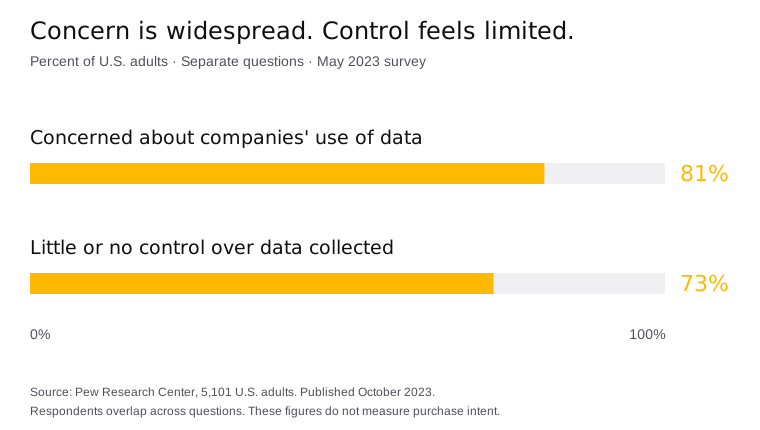
In Pew's 2023 survey, 73% of U.S. adults felt they had little or no control over data companies collected about them. In a separate 2025 survey, 61% wanted more control over AI in their lives. That supports taking control seriously. It does not tell me how many people will want what I build. Pew, data privacy · Pew, AI control
The largest AI companies rarely talk about private AI that runs on your own hardware. It works against how they make money. I think the world will split in two. Some people will get cheap intelligence and pay for it with their data and their privacy. Others will be able to afford full privacy.
This is why I want the intelligence to run on a private server in your home. The memory stays with you. You decide what it can access and what it is allowed to do.
Open models are catching up
On-premise, open source, open weight, local. A few years ago these words belonged to large companies with their own data centers and to single developers experimenting at home. They are becoming ordinary. Ollama, a free tool for running models on your own machine, reached nearly 9 million developers a month in 2026, and its CEO says it is used in 85 percent of the Fortune 500. TechCrunch, 2026
The models have caught up too. The best open models now trail the best closed ones by about four months. Alibaba's Qwen is the most used open family: its downloads on Hugging Face passed Meta's Llama in 2025 and were almost double Llama's by March 2026. Its 27-billion-parameter model is the strongest open model of its size, the kind that runs on a computer at home. Qwen is the model family I intend to run in Local. Epoch AI, 2026 · ATOM Report, 2026 · Artificial Analysis, 2026
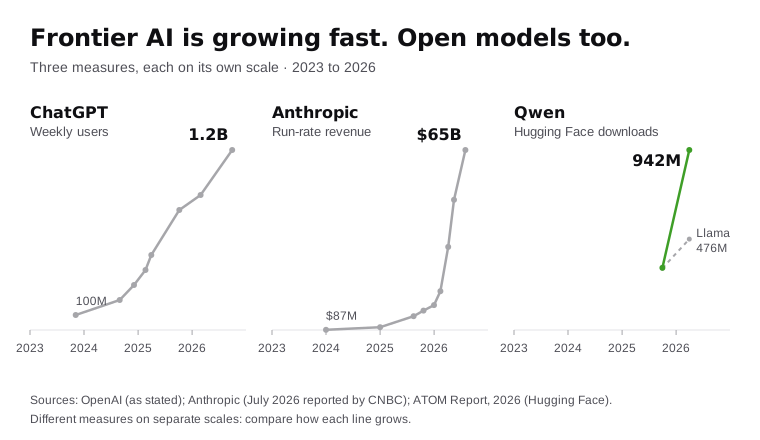
I believe local models will stay less popular than the frontier models for a long time. At the end of 2025, open models held 11 percent of enterprise AI use. Their growth will come first from companies that want their data to stay private, and later, I hope, from people who realize the same. That is the bet behind Local. Menlo Ventures, 2025
AI can now act
What lets AI take actions for you is the agent harness. A language model on its own predicts the next word. A harness is the software around it that gives the model tools, a memory, and the ability to act and to improve its own skills. It is the step from predicting text to finishing your presentation, booking your flights, or building your website. Google Cloud, 2026
Agent harnesses
I built my own agent. It lives on my own server, and I have used it for more than six months. At any time of the day I can send it a message on Telegram. When a task is complex, it schedules the work and builds it overnight. Later I joined Jarvis, a team building a harness in the same family as OpenClaw and Hermes, with a stronger memory and workflows that run as code. Jarvis is the harness Local runs on.
The big companies noticed fast. In February 2026, as OpenClaw spread, OpenAI hired its creator to build the next generation of personal agents, and the project moved to a foundation that OpenAI supports. In April, Anthropic stopped covering OpenClaw and other harnesses from its subscriptions, so their users paid per token instead. TechCrunch, February 2026 · TechCrunch, April 2026
Almost everything in AI is now a subscription or a token bill. You pay every month, and you pay again for every task an agent runs. Some Claude subscribers paying $20 to $200 a month were using hundreds, even thousands, of dollars of tokens through their agents. VentureBeat, 2026
Meanwhile, intelligence keeps getting cheaper. Epoch AI estimates that the cost of a given level of AI performance has fallen about 13 times a year since 2023. ChatGPT's most expensive plan still went from $20 a month in 2023 to $500 in September 2026. I expect intelligence to become very cheap. I also expect these companies to keep finding ways to charge for it. A model running on your own server at home has no token bill. Each task it runs costs only the electricity it uses. Epoch AI, 2026 · TechCrunch, 2023 · The Next Web, 2026
How Local keeps your data yours
Local starts from ownership. The model runs on your private server at home, and you know where your data comes in and where it goes. That will need to be enforced with strong encryption, careful cybersecurity, mathematical algorithms, and smart contracts, so your data only moves the way you allowed.
Your data stays yours. If you choose, it can earn.
- An AI tool you work withonly the part you choose to share
- A health insurerthat lowers your premium
What they pay goes to you, and to nobody else
Each permission is written down as a smart contract and enforced by code rather than by a promise. That also lets you earn from your data. Your band tracks your training, and the record stays on your server at home. You can share with your health insurer only the part that shows you trained, and it can lower your premium in return. It sees that part and nothing else. You can switch it off at any time. It is a direction for later, and no plan of mine depends on it yet.
What I am building
Local is your private AI, running on your own network at home. Experience is the larger vision: creating and connecting real life, starting from what your private AI knows about you. It is a big vision with several phases, and it starts with Local, the part that is grounded and simple. I have built the full deck and a three-year financial model for Local, and I am already speaking with investors. If you would like to see them, write to me.
Local starts with a screenless band and a private server at home. Together, they let the AI remember context and prepare work while you go about your day. Later, other devices can join your network, provided their makers keep no copy of your data. I would like that to become a new standard for how devices share what they know about you.
There are many ways to use it. Take health. The band tracks your body, the record stays private, and you can share it with your doctor. Instead of a check-up once a year, there is a check-in every day. Because the AI knows you well and your data goes nowhere, it can notice when something is slightly off and tell you to pay attention.
Or take work. Press the band in a meeting, and Local remembers what was said, so it can get started in the background. You meet someone and talk about an idea you want to look into. By the time you are home and open your laptop, the research is done and waiting for you in a few open tabs. There are more uses, like helping you be more aware and more organized, and we can talk about them. If you have ideas of your own, I would like to hear them.
This is where Local meets Experience. An AI that knows how you slept, how you feel, and what is on your mind can suggest an experience that changes your day. This August I was feeling down and almost canceled one of the best trips of my year. I went only because my friends pushed me. Afterwards I could look at myself from the outside. My friends had seen what I could not: my blind spot.
Living experiences is how we grow. We challenge ourselves, meet new people, and talk to people we would not otherwise meet. Technology alone cannot give us that. It can be the tool that gets us there.
What Experience will do
Once Local has become a company, raised its first round, shipped its first devices, built the infrastructure, and proven that people need it, Experience is the next phase. It will grow in three steps, and each step makes the next one possible.
First, connect people with experiences that already exist. The people who run great dinners, workshops, runs, and trips are already out there, on Airbnb Experiences, Fever, Strava clubs, and in a thousand communities with no platform at all. Run club participation grew 59 percent worldwide in 2024. Hyrox went from 570,000 athletes in a season to 1.5 million in one year. The demand does not need to be created. What is missing is the match: an AI that knows your week, your energy, and what you said you wanted, and can put the right evening in front of you. That is where Local and Experience first meet, and it is why Experience begins as a partner to the companies and hosts who already organize real life, and never as their competitor. Strava, 2024 · SportsPro, 2026
Second, fund exceptional experiences, and back the people who create them. Some people's life mission is to create better experiences for others. They are usually underfunded and undertooled. Experience will invest in them, acquire teams when that is the right structure, and give them the tools, the audience, and the standards to do more of what they are good at. Burning Man taught me what happens when a few hundred people are given the means to build something for everyone else. I want that to be repeatable.
Third, organize our own. The first will be the mind gym. People train their bodies because the results are visible. Nobody trains the mind on purpose, and as AI takes over more thinking, the muscles that matter most, attention, memory, communication, curiosity, and the ability to sit with a hard question, get less use every year. The mind gym is a place and a practice for training exactly those: sessions on thinking, on listening, on debate, on making something with your hands, with other people in the room. Training the mind should become as normal as training the body, so that people keep thinking for themselves while their AI does the rest. I expect it to start small, as gatherings in one city, and to grow the way running clubs grew: because people bring their friends.
Why I want to build this
My previous startup brought people together through events and activities. I still believe the mission was right, but the execution had moved toward squeezing revenue, and I lost the spark of building something I believed in.
After the exit, I spent a year teaching, traveling, and living experiences. I also tried to understand what had stopped working for me, including through Vipassana and other retreats. Burning Man, and the experiences and connections that came out of it, helped me return to a purpose I could recognize: helping people do more things and meet more people.
Curiosity also pulled me into cybersecurity, hosting, and servers. I spent about a month at my laptop learning how they worked. I enjoy going that deep into technology. Teaching AI has given me another way to spend time with people while working on something that interests me.
I am not a robot. I do not want to do one thing in my life. Spending time with people and working on innovation are both my purpose. When I did only one or the other, I was miserable. Local is the innovation. Experience is the people. This is the first time I get to build both at once.
I want to build a company I can keep believing in as it grows. I do not want Local to be a heartless company. I want it to have the soul of Experience behind it, so people understand what kind of community they are joining and what their technology is meant to help them do.
Who I want to hear from
I want to hear from people who believe private AI can help us spend more of our lives with each other. If you want to build the tools, create experiences, or introduce me to someone who should be part of this, write to me. I would like to know what you see in this idea and where you think it needs more thought.
Ilia Vasko · 30 September 2026